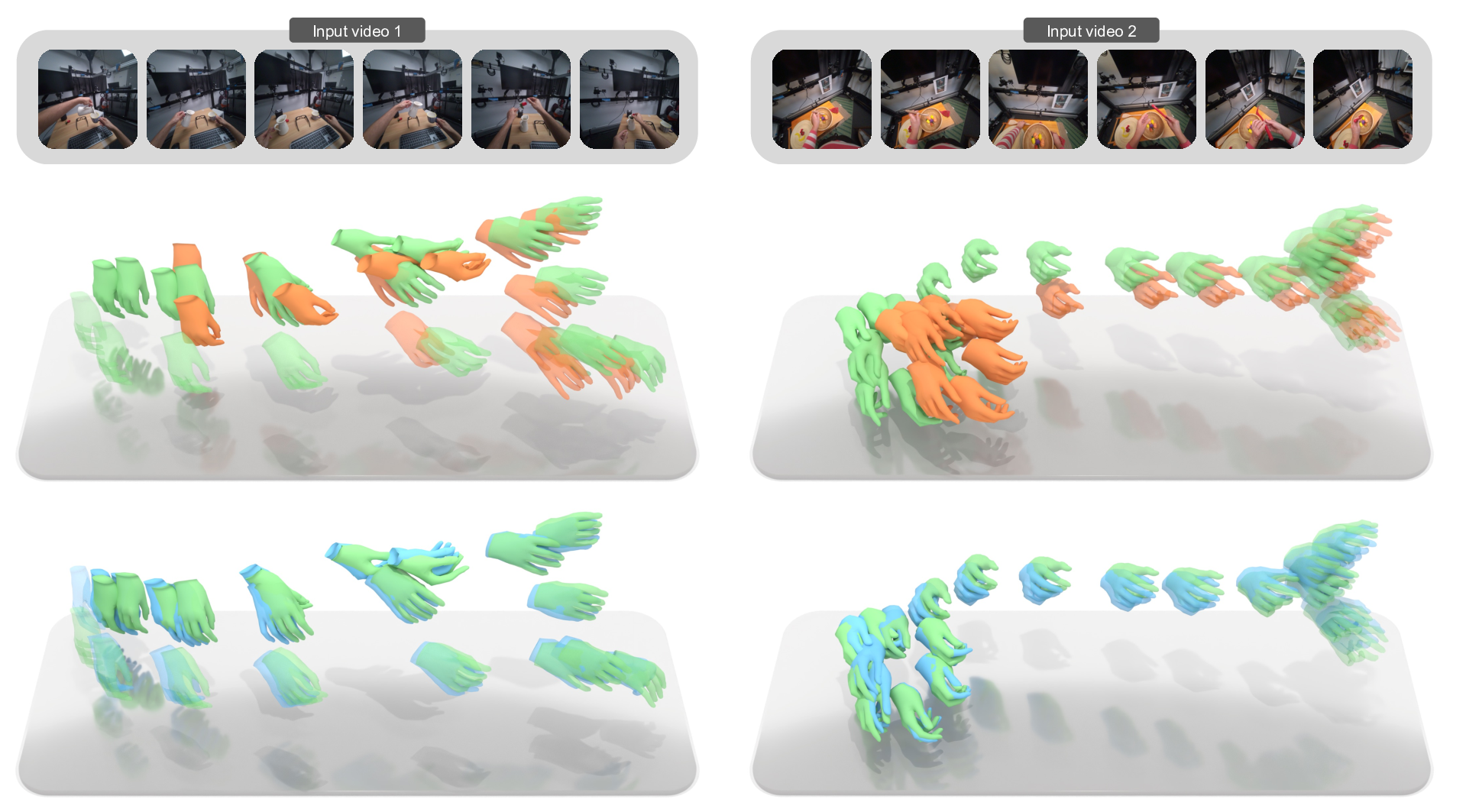
Accurate monocular 4D hand reconstruction remains challenging. Per-frame discriminative regressors lack temporal context and often produce jittery predictions. Temporal models improve consistency by aggregating information across frames, but they are typically deterministic regressors, making them vulnerable to ambiguous observations caused by occlusion and motion blur. Generative modeling offers a natural alternative by learning a prior over plausible hand motion sequences, enabling coherent hand-state recovery when visual evidence is incomplete or unreliable.
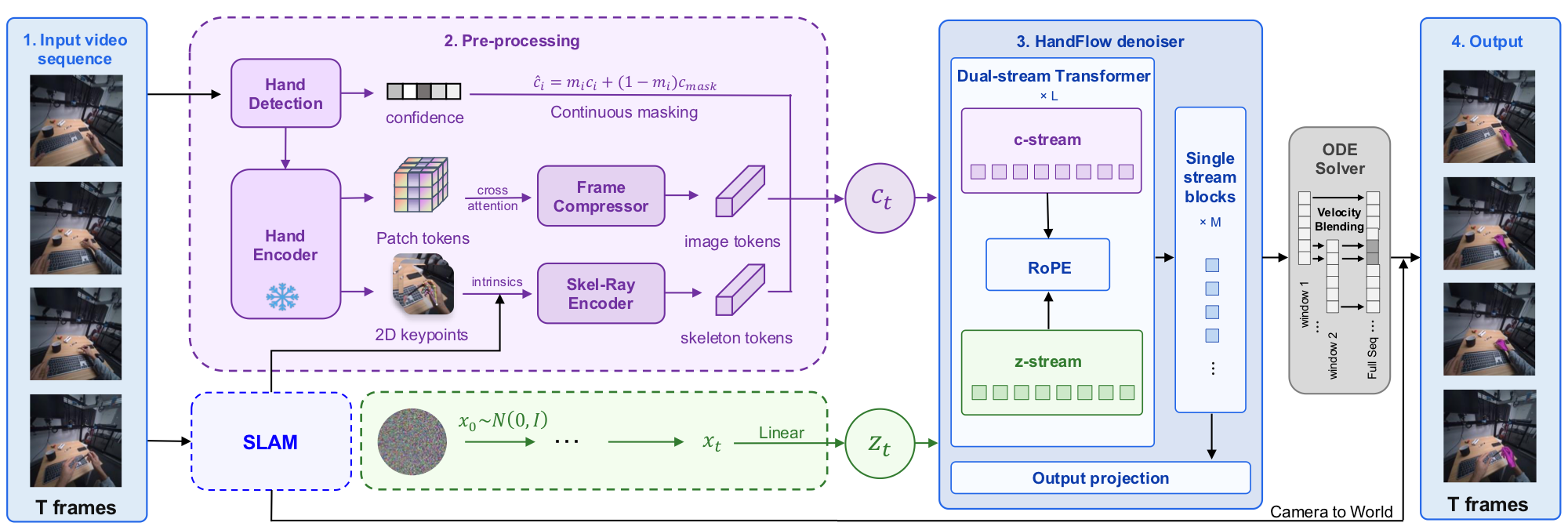
Motivated by this observation, we present HandFlow, a fully generative flow-matching framework for temporally coherent 3D hand pose and shape estimation from monocular video. We formulate 4D hand reconstruction as conditional generation in the MANO parameter space. Given visual and skeletal observations, HandFlow denoises an entire temporal window of joint poses, global translations, and hand shape through a single ODE integration. To capture long-range temporal dependencies, we design a Flux-style dual-stream transformer that jointly attends to latent hand parameters and visual-skeletal conditions across the full sequence, avoiding the sequential bottleneck of autoregressive decoding. To handle noisy or missing observations, we introduce a continuous masking mechanism that blends observed conditional features with learnable mask tokens according to per-frame hand confidence scores.
Experiments on DexYCB and HOT3D show that HandFlow achieves state-of-the-art performance, with particularly large gains in world-space accuracy and temporal smoothness. It reduces world-space pose error by over 30% compared with the strongest baseline and achieves the lowest acceleration error among all evaluated methods, while remaining competitive in per-frame pose accuracy. Moreover, on a single GPU HandFlow reconstructs a 150-frame sequence at ≈47 fps, about 12× faster than the fastest prior video-based method, with reconstruction itself accounting for only a small fraction of the end-to-end latency.